Introduction
You don't need to be a "spammer" to get blocked like one.
Many legitimate businesses assume that because they don't buy shady lists, they are safe from spam traps. This is a dangerous misconception.
Spam traps are not just for criminals. They are the primary weapon Internet Service Providers (ISPs) use to identify senders with poor data hygiene. If you hit one, the damage is immediate: your emails go to junk, your domain reputation tanks, and your ROI evaporates.
Here is exactly what spam traps are, how they ended up in your database, and how to remove them before they trigger a block.
What is a Spam Trap?
Think of a spam trap as a "tripwire" hidden in your email list.
To the naked eye, it looks like a normal email address. It has a valid format (e.g., john.doe@yahoo.com). But there is one crucial difference: it belongs to no one.
It has no owner, it never signed up for your newsletter, and it never asked for your product. Therefore, if you send an email to a trap, the ISP knows—with 100% certainty—that you are emailing people who did not opt in, or that your data management is negligent.
The two types of traps (and how you hit them)
You don't need to buy a list to acquire a trap. They often appear naturally through data decay.
- Recycled Traps (The "Old Data" Trap) These are old email addresses that were once valid but were abandoned by the user.
-
- Example: An employee leaves a company, or a user stops logging into their old Hotmail account.
- The Danger: After a period of inactivity, the ISP reactivates the address as a trap. If you are still emailing marketing@company.com three years after that employee quit, you are signaling to the ISP that you do not clean your list.
- Pristine Traps (The "Honey Pot") These are addresses created solely to catch scrapers and bots. They are hidden in the code of websites but invisible to humans.
-
- The Danger: If one of these ends up in your list, it means your data source is fundamentally corrupt (likely scraped). This carries the heaviest penalty.
The consequence: Why one trap matters
You might think, "I have 100,000 contacts; does one bad email matter?"
Yes.
ISPs like Gmail and Outlook use these traps to judge your Sender Reputation. Hitting a trap acts as a distinct "negative signal."
- Immediate impact: Your emails are routed to the Spam folder for everyone—even your loyal customers.
- Long-Term impact: Your IP address is added to a blocklist (like Spamhaus), forcing you to halt operations while you appeal the block.
You cannot simply "wait out" a reputation hit. You have to fix the root cause: the data.
How to Fix It
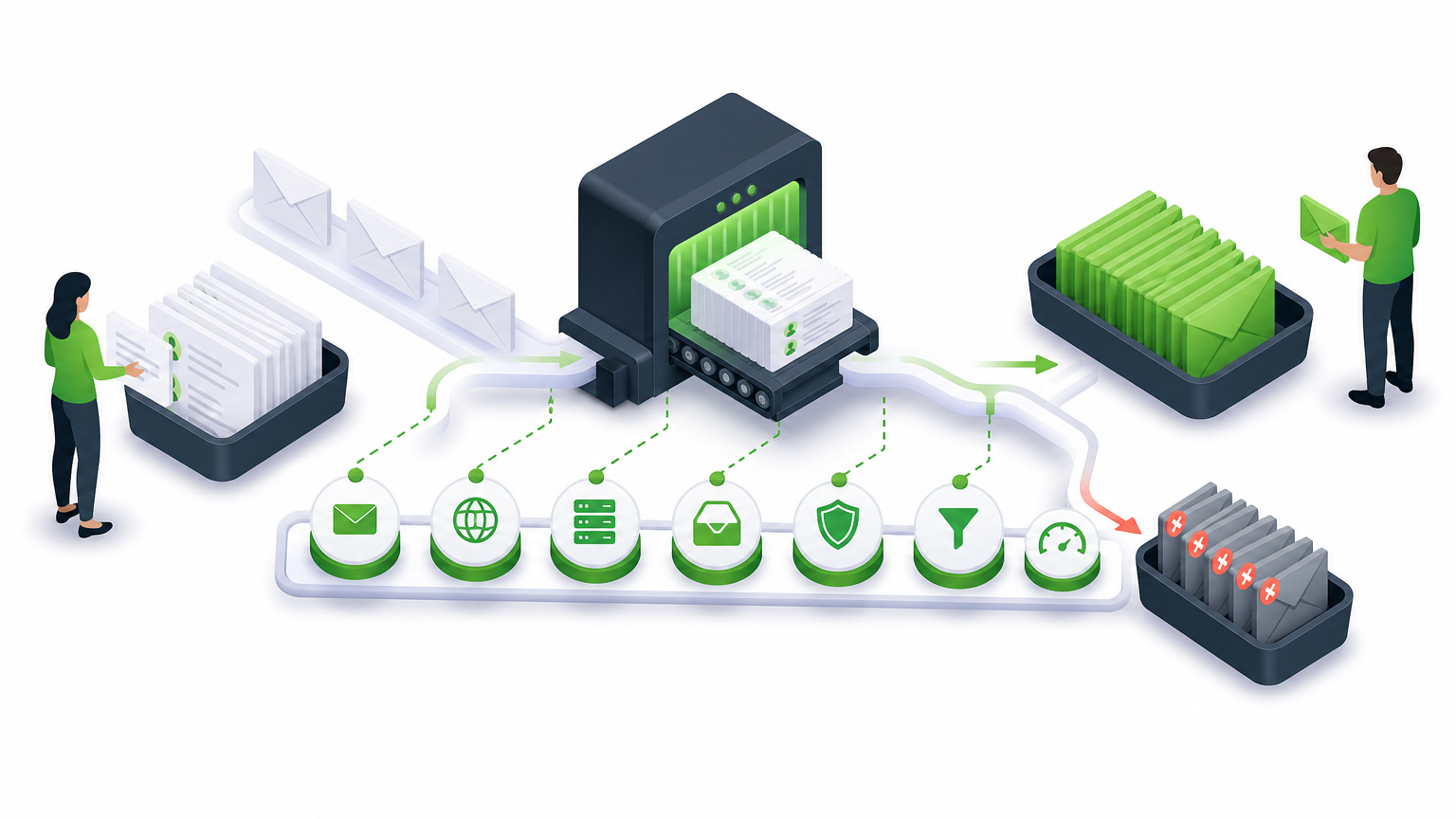
Spam traps do not "bounce" like normal invalid emails. They often look delivered, which makes them impossible to spot with the naked eye. You need professional tools to identify and remove them.
- Clean your existing list (The cure) If you haven't cleaned your database in over 6 months, you are sitting on a ticking time bomb of recycled traps.
-
- Solution: Run your database through CORE. It identifies toxic domains and known traps, allowing you to purge them before your next campaign.
- Verify at the gate (The prevention) Cleaning once isn't enough. If your sign-up form allows typos or bots, you will simply re-infect your list.
-
- Solution: Use a real-time API like MORE on your forms. This blocks bad data at the point of entry, ensuring only valid, real humans enter your ecosystem.
Conclusion
Spam traps are a symptom of a larger problem: data decay.
If you are hitting traps, it’s not bad luck. It’s a sign that your data processes are failing. Stop risking your reputation on "good enough" data. Clean your list, protect your forms, and keep your emails where they belong—in the inbox.
Clean Your List with CORE