
 Adam
Adam
.png?width=896&height=504&name=fake-email-02%20(2).png) Fake email addresses show up more often than most teams realise. Sometimes they’re innocent mistakes, such as a customer mistypes their address. Sometimes they’re temporary inboxes used for free trials or discount codes. And sometimes they’re a deliberate attempt to hide identity or carry out fraud.
Fake email addresses show up more often than most teams realise. Sometimes they’re innocent mistakes, such as a customer mistypes their address. Sometimes they’re temporary inboxes used for free trials or discount codes. And sometimes they’re a deliberate attempt to hide identity or carry out fraud.
A fake email address checker is designed to catch those issues before they cause problems. Instead of sending a test message, it runs technical checks in the background to confirm whether an email address is real, safe and able to receive mail. The real value lies in prevention. Clean, trustworthy data makes everything else work better.
Why fake emails cause so much trouble
The symptoms usually show up long before the cause is obvious. Campaigns underperform. Bounce rates creep up. CRM fields stop making sense. Trial sign-ups look high, but conversion rates remain low.
These issues usually stem from too many invalid or risky email addresses. This is explored in more detail in our post on verifying email addresses without sending email.
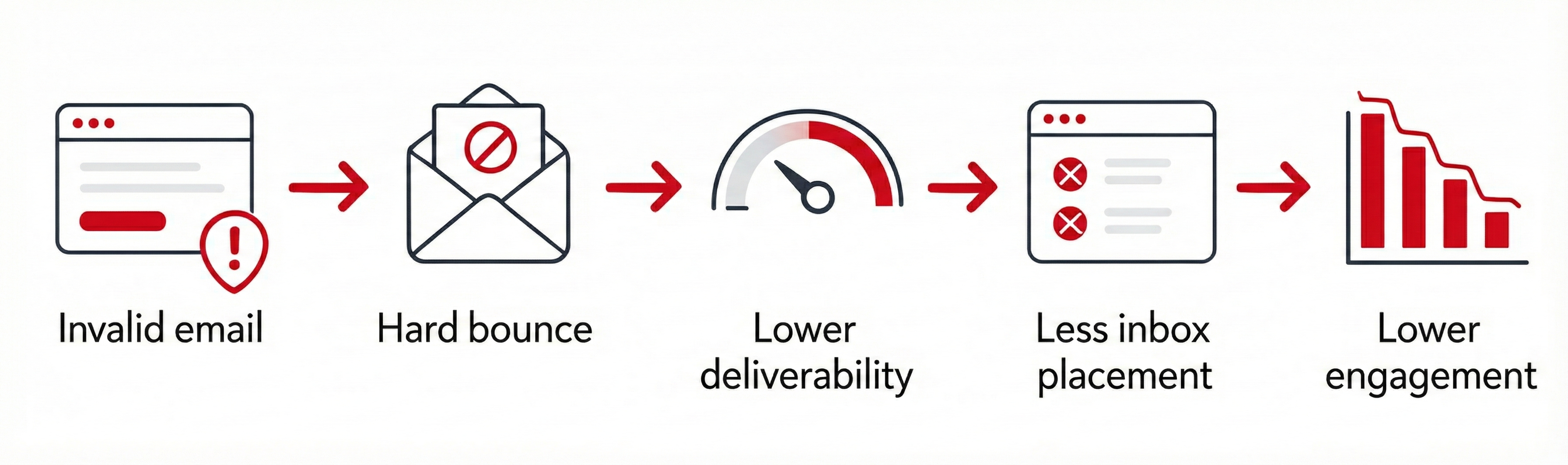
To illustrate, imagine a user entering john.smilth@gmial.com into your form. Without validation, this one typo becomes a hard bounce, harms deliverability and wastes a marketing touch.
Disposable email services create different challenges. A user signs up, claims a free trial or discount, and then disappears. These addresses rarely engage beyond a single interaction and can be used to exploit free trials or promotions. For organisations offering accounts or trial access, fake emails are often an early sign of abuse or fraud..
All of this results in poor data, weaker deliverability, inflated marketing costs and less reliable reporting. If this has happened to you, take a look at our how to improve email reputation post which may be helpful.
How a fake email address checker helps
A verification tool examines an email address in several ways:
- It checks that the format is correct.
- It verifies that the domain exists and can accept mail.
- It attempts to confirm whether the mailbox itself is real.
- It identifies whether the address comes from a disposable or temporary domain.
These checks work together to reveal whether the email is genuine and whether it’s safe to store.
The main advantage is preventing bad data from entering your systems in the first place. A checker reduces bounces, protects deliverability, keeps your CRM cleaner and helps prevent bot sign-ups or suspicious behaviour.
How Email Hippo approaches email verification
Email Hippo’s tools are built to solve these real-world problems, not just to confirm whether an inbox exists.
MORE is a real-time email verification API that checks new email addresses the moment they are submitted. It returns fast, essential validation results so you can prevent invalid, disposable or risky emails from entering your database. This makes it suitable for sign-up forms, lead capture pages and any workflow where data quality matters at the point of capture.
CORE provides deeper checks for existing lists. It is designed for teams preparing major campaigns, auditing CRM data or recovering from poor deliverability. Each address receives a clear result code, making it easy to identify which contacts are safe to keep and which ones need attention. You can learn more about this in our post on why email list cleaning matters.
INSIGHT is a developer-focused verification API that returns more granular data points and deeper technical intelligence. It is suited to businesses that need richer validation outputs inside their own systems, applications or fraud workflows.
ASSESS analyses technical signals and domain intelligence to indicate whether an email address may represent a fraud risk. It returns a clear risk score so teams can make informed decisions earlier in the process.
Email Hippo has been verifying email addresses since 2000 and is ISO 27001 certified. This long-standing experience and security accreditation offer reassurance to organisations that depend on accurate, privacy-safe verification.
Where verification fits in day-to-day operations
Most teams use verification in two places:
- At the point of capture, where real-time checking improves the quality of every new lead or sign-up.
- When working with existing data, where bulk cleaning keeps CRMs, marketing systems and customer databases trustworthy.
Both approaches help maintain healthier data, stronger inbox placement and more accurate reporting.
Frequently asked questions
How do I know if an email address is fake?
A fake email address checker performs technical checks such as domain validation, mailbox detection and disposable email identification to confirm whether the address is real and able to receive messages.
Can you verify an email without sending one?
Yes. Verification tools like MORE and CORE perform a series of non-intrusive checks that confirm deliverability without issuing a test email - sign up for a free trial.
Do I need real-time verification or bulk verification ?
Real-time verification prevents bad data from entering your systems. Bulk verification helps clean large databases and prepare for campaigns. Many teams benefit from using both.
Why are disposable emails a problem?
They inflate lead numbers, skew engagement metrics and are often used to exploit free trials, promotions or automated workflows.
Final thoughts
Fake email addresses influence data quality, deliverability, analytics, costs and even security. A fake email address checker gives businesses clarity and confidence by ensuring the data they rely on is genuine.
Email Hippo’s suite: MORE, CORE, INSIGHT and ASSESS supports every stage of the verification process, from real-time capture through to fraud detection and list hygiene. If you're reviewing your data quality strategy, our team can help you choose the right approach. You can contact us for guidance or try Email Hippo’s verification tools free today.