
 Adam
Adam
Bounced emails get noticed because they're visible - a number on a dashboard, a red flag in a report. What's harder to see is everything that number doesn't capture: the contacts you're still paying to store even though they'll never open anything, the campaign that got blamed for "weak creative" when the real problem was who it was sent to, the hour someone on your team spent last Tuesday trying to figure out why the numbers looked off.
None of that shows up as a single line item. It's scattered across your platform bill, your CRM, your reporting, and your team's growing habit of not quite trusting the data in front of them.
What "poor data" actually covers
People tend to picture obviously fake addresses, gibberish strings, typos, the sort of thing a basic filter should catch. That's part of it, but a smaller part than most people assume.
The bigger issue is addresses that were once real and aren't functioning anymore. Someone left their job eighteen months ago and the inbox was closed the same week. A contact signed up with a throwaway address just to get a discount code and never checked it again. A domain a company used got dropped when they rebranded. None of these look wrong at a glance as they're syntactically fine, they were valid once, and a list can be full of them without anything looking obviously broken.
This is also why a big number in your CRM doesn't tell you much on its own. Fifty thousand contacts sounds like a healthy list until you ask how many of those addresses would actually accept an email today. Databases don't stay accurate just by sitting still, people change jobs, companies fold, domains expire, so a list that was clean when it was built can quietly degrade without a single new contact ever being added.
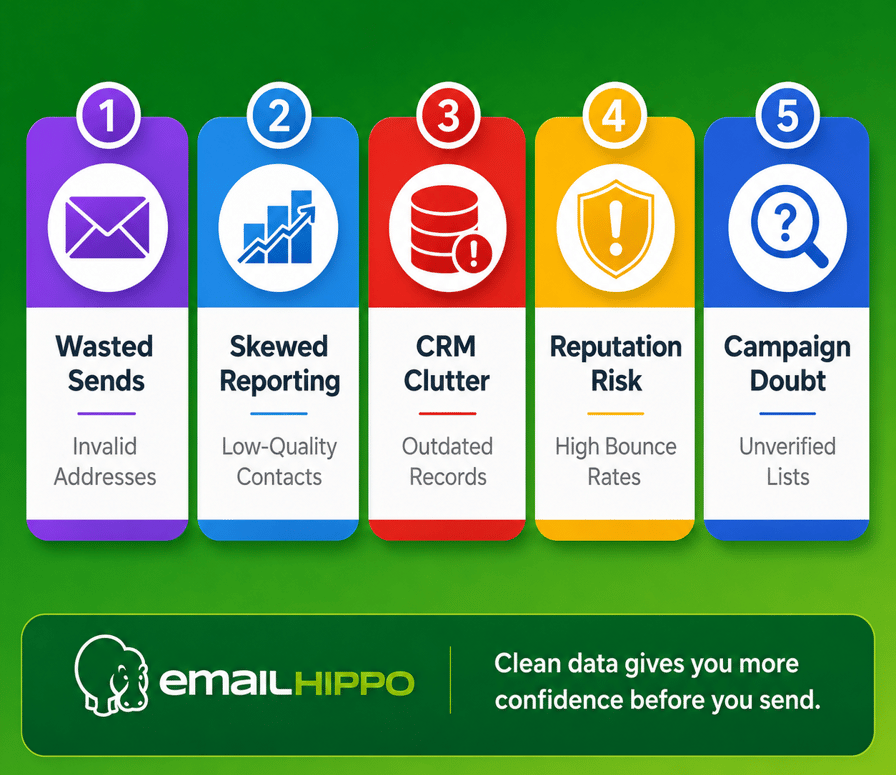
Where the money actually goes
Start with the boring part: most email platforms charge based on how many contacts you store or how many emails you send. An address that bounces every single time still counts toward both. You're paying for it exactly as if it worked.
Then there's the time cost, which is less obvious mainly because it's spread across different people rather than showing up in one place. Someone notices bounce rates crept up and has to dig into why. Someone else pulls records to check for duplicates before a big send. If a campaign underperforms, someone has to work out whether that's a content problem or a data problem before anyone can fix anything and that investigation itself takes time nobody budgeted for.
There's a subtler cost too, which is that your list size stops meaning anything. If a third of your database can't actually be reached, then your "50,000 contacts" is really closer to 33,000, but every forecast and budget conversation still uses the bigger number, because that's the number in the system.
Reporting starts telling you the wrong story
When a campaign underperforms, the instinct is almost always to look at the campaign itself. Was the subject line weak? Wrong send time? Offer not compelling enough? These are reasonable things to check.
But if a meaningful chunk of the list was never going to receive the email in the first place, you're diagnosing a data problem as a creative problem. The engagement rate looks bad not because the message failed, but because it was measured against people who were never in a position to see it. Teams then go rework the copy or retarget the audience, chasing a fix for a problem that wasn't actually there.
A clean list doesn't make anyone open an email. What it does is make your numbers mean what you think they mean, so that when a campaign genuinely underperforms, you can trust that the fix belongs on the creative side and not the data side.
Your CRM only works if people believe it
Here's a pattern that shows up in a lot of sales and marketing teams: someone finds three duplicate records for the same contact, or an address that's bounced for six months straight, and they quietly start keeping their own spreadsheet on the side. Multiply that by a few people over a few months and you end up with several slightly different versions of "the truth" floating around, none of which fully agree with each other.
That's a CRM confidence problem, and it rarely stays contained to the CRM. Sales tools, marketing platforms, and reporting dashboards are usually all drawing from the same underlying records, so whatever's wrong in one place tends to be wrong everywhere it's connected. Fixing the CRM directly is more effective than trying to patch each downstream symptom separately, and the fix usually starts with knowing which addresses in there are actually still good.
The deliverability cost is the one that compounds
Mailbox providers watch how senders behave over time (bounce rates, spam complaints, engagement patterns) and they use that history to decide what happens to your next email before a human ever sees it. Send to a lot of invalid email addresses regularly and you build a track record that starts working against you, even on emails going to people who genuinely want to hear from you.
This is the cost that's easy to miss because it doesn't show up immediately. A single send to a bad list won't tank your reputation. A pattern of it, over months, gradually makes it harder for your legitimate emails to land in the inbox at all, which means you're now paying for bad data twice: once in the original send, and again in the reduced performance of every send after it.
When it's worth actually checking
Not every list needs a full audit before every send. But a few situations are worth flagging in particular: lists that haven't been used in a while, anything pulled together from multiple sources or systems, and any send large enough that even a small bad-data percentage adds up to real numbers.
It's also worth doing if nobody on the team can actually say when the list was last checked. Read our guide to email list cleaning for more practical advice on reviewing and maintaining your data
What Email Hippo CORE does with an existing list
CORE is built specifically for checking lists you already have. You upload the file, it verifies each address, and you get back a breakdown of what's valid, what's not, and what falls into a grey area that needs a human decision rather than an automatic one.
It's used before big campaigns, during CRM cleanups, or just when someone finally decides to find out what's actually sitting in an old list that's been untouched for a year or two. The output doesn't make decisions for you - it gives you the information to make them yourself, rather than finding out the hard way after a send has already gone out.
The real question
A contact count tells you how many rows are in a spreadsheet. It doesn't tell you how many of those people you can reach, which is really the only number that matters when you're planning a campaign or reporting on one.
Checking your list won't fix a weak subject line or a bad offer. But it will make sure that when something does go wrong, you're looking at the right cause and when something goes right, you know the number behind it is real.